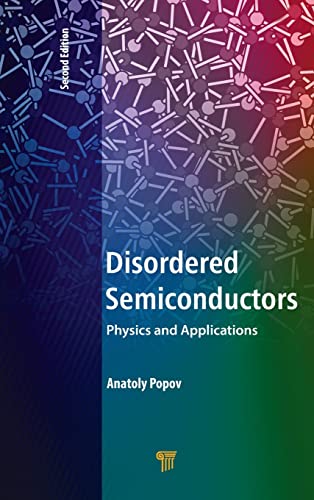
Devices based on disordered semiconductors have wide applications. It is difficult to imagine modern life without printers and copiers, LCD monitors and TVs, optical disks, economical solar cells, and many other devices based on disordered semiconductors. However, nowadays books that discuss disordered (amorphous, nanocrystalline, microcrystalline) semiconductors focus, as a rule, on either physics of materials or physics of devices that are based on these materials. This book connects characteristic features of the atomic and electronic structures of disordered semiconductors and the device design process on the basis of these materials.
Compared with the first edition, this book takes into account the latest developments of disordered semiconductors and devices. It has new sections on the structures of carbon-based amorphous and nanocomposite films and atomic and electronic structures of organic semiconductors.
Devices based on disordered semiconductors have wide applications. This textbook connects characteristic features of the atomic and electronic structures of disordered semiconductors and the device design process on the basis of these materials.
Preface 1. Introduction 1.1 Definition of Disordered State 1.2 Classification of Non-crystalline Systems 1.3 Qualitative and Quantitative Characteristics of Glass Formation 2. Atomic Structure of Disordered Semiconductors 2.1 Structural Characteristics of Solids 2.2 Short-Range and Medium-Range Order 2.3 Methods of Investigation of Disordered System Structure 2.4 Simulation of Disordered Material Structure 2.5 Results of Structural Research of Disordered Semiconductors 3. Electronic Structure and Properties of Disordered Semiconductors 3.1 Electronic Structure 3.2 Electrical Properties of Disordered Semiconductors 3.3 Optical Properties of Disordered Semiconductors 3.4 Photoelectrical Properties of Disordered Semiconductor