VIRGINIA GARDNER TROY is a scholar of twentieth-century art and design and a professor of art history at Berry College. She is the author of two books,
The Modernist Textile: Europe and America, 1890-1940 and
Anni Albers and Ancient American Textiles: From Bauhaus to Black Mountain. She has also published articles on mid-twentieth-century weaving, Appalachian weaving, Marie Cuttoli, and many other subjects. She lives in Rome, Georgia.
Mary Crovatt Hambidge (1885–1973) was an aspiring actress and a professional whistler on Broadway when she met Canadian-born Jay Hambidge (1867–1924), an artist, illustrator, and scholar. Their relationship would prove to be both a romantic and an artistic partnership. Jay Hambidge formulated his own artistic concept, known as Dynamic Symmetry, which stipulated that the compositional rules found in nature’s symmetry should be applied to the creation of art. Mary Hambidge pioneered new techniques of weaving and dyeing fabric that merged Greek methods with Appalachian weaving and spinning traditions. The Hambidge Center for Creative Arts and Sciences, formed during the mid-1930s, provides an artists’ community situated on six hundred rural acres in the north Georgia mountains where hundreds of visual artists, writers, potters, composers, dancers, and other artists have pursued their crafts.
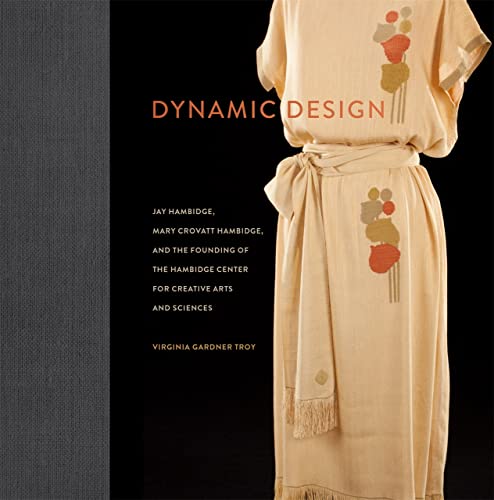
Dynamic Design details Jay Hambidge and Mary Crovatt Hambidge’s cross-cultural and cross-historical explorations and examines their lasting contributions to twentieth-century art and cultural history. Virginia Gardner Troy illustrates how Jay and Mary were important independently and collectively, providing a wider understanding of their lives within the larger context of late nineteenth- and early twentieth-century art and design. They were from two different worlds, nearly a generation apart in age, and only together for ten years, but t