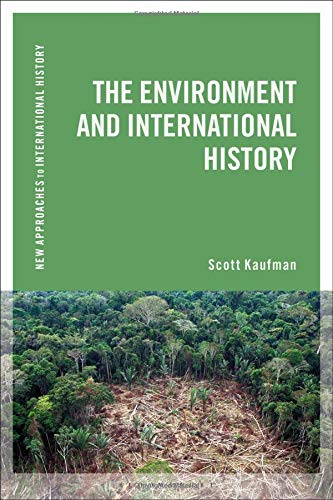
Studies of the history of international relations traditionally have focused on the decisions made by those at the highest levels of government. In more recent years, scholars have expanded their attention to cover economic, cultural, or social interactions among nations. What has remained largely ignored, however, is the impact of an increasingly-interdependent world upon the environment and, conversely, how environmental concerns have affected the ecology, social relationships, economics, and politics at national, regional, and global levels.
The Environment and International Historyfills this gap, looking at the interrelationship between international politics and the environment. Using a transnational and interdisciplinary approach, this book examines how imperialism, war, and a divergence of interests between the developed and underdeveloped world all have had implications for plants, animals, and humans worldwide.
Scott Kaufmanis Professor of History at Francis Marion University, USA.
�Scott Kaufman's book offers a concise, fast-paced tour through the development and acceleration of both humanity's devastation of the natural world, and our collective efforts to combat this destruction. Helpfully addressing marine, terrestrial, and avian species, and spanning developments in war and politics, Kaufman lays out an unmistakable historical arc: as human impacts have grown more severe, culminating in global impacts from climate change and rising extinction rates, so have concerted international efforts to minimize harm and protect nature. Kaufman's book is a clear, well-researched text that will appeal to students of all ages.� �Rebecca H. Pincus, Assistant Professor of Strategic and Operational Research, Naval War College, USA
�Sweeping and accessible, The Environment and International History provides a concise and compelling survey of nature conservation efforts on a global scale. Kaufman clearly demonstrates the centrality of internat