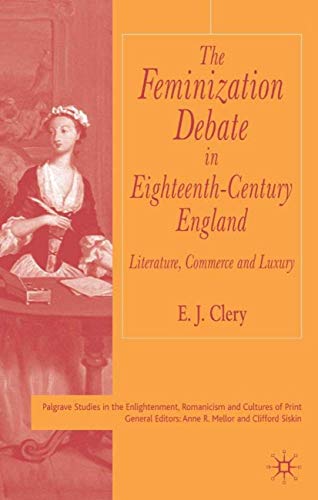
In the Eighteenth-century, critics of capitalism denounced the growth of luxury and effeminacy; supporters applauded the increase of refinement and the improved status of women. This pioneering study explores the way the association of commerce and femininity permeated cultural production. It looks at the first use of a female author as an icon of modernity in the Athenian Mercury , and reappraises works by Elizabeth Singer Rowe, Mandeville, Defoe, Pope and Elizabeth Carter. Samuel Richardson's novels represent the culmination of the English debate, while contemporary essays by David Hume move towards a fully-fledged enlightenment theory of feminization.List of Illustrations Abbreviations Acknowledgements Introduction Sexual Alchemy in the Coffee House The Athenian Mercury and the Pindarick Lady The South Sea Bubble and the Resurgence of Misogyny: Cato, Mandeville and Defoe Elizabeth Carter in Pope's Garden: Literary Women of the 1730s Clarissa and the 'Total Revolution in Manners' Out of the Closet: Richardson and the Cult of Literary Women Coda: From Discourse to Theory of Feminization in the Essays of David Hume Notes Bibliography Index
'The Feminization Debate in Eighteenth-Century England is an elegantly written, trenchant and persuasive analysis of how the category of the feminine was used in order to chart economic growth and to assess its impact on the social fabric of England. Particularly in the Introduction, Clery provides a useful overview of historical and literary scholarship of the period and throughout she illuminates the study of feminism in general and its English history in particular by showing how discourses of the feminine were largely (though not exclusively) about masculinity, virtue, and authority in an emerging commercial economy. This consistently original and provocative study fulfils its promise to restore a sense of wonder to the early history of capitalism and in the process impressively inaugurates the 'Palgrave Studies in The