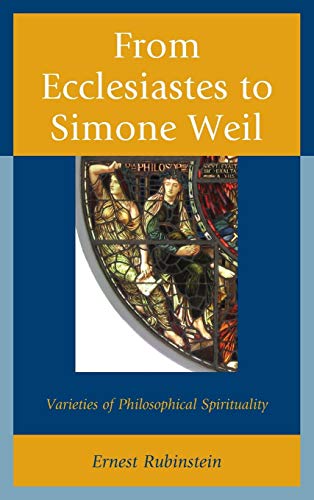
From Ecclesiastes to Simone Weil: Varieties of Philosophical Spirituality reads major philosophers from the Western philosophical canon and beyond for the spirituality implicit in their metaphysics, epistemology, ethics, aesthetics, and logic. Its aim is to revive for the modern reader the spiritual import of philosophy as an area of inquiry and study. Spirituality is understood as a lived orientation towards the sacred. The sacred is characterized as the source of all being and human wellbeing. Philosophy is presented as an avenue of approach to the sacred alternative to the western religious traditions. Philosophers treated include Plato, Descartes, Spinoza, Kant, Hegel, Kierkegaard, Emerson, William James, Bertrand Russell, and Simone Weil.Ernest Rubinstein is adjunct assistant professor of humanities at the New York University School of Continuing and Professional Studies and associate librarian emeritus at Drew University.
�With a novel take on 14 philosophers, Rubinstein reintroduces a historical conception of philosophy as wrestling with the spiritual and thus becoming therapy, at least for the philosophers themselves. Recognizing that philosophy has, over the centuries, fractured into many quarreling silos of thought, this book attempts to find the common source of spirituality that philosophy has always had at its core. By defining spiritualityin terms of 'a non-exclusive humanism,' Rubinstein is able to broaden the concept to include ontological or epistemological transcendence. This allows for inclusion of Bertrand Russell�s aesthetics, as well as the almost existential musings of the tacitly earthly Ecclesiastes. . . .Summing Up: Recommended. Upper-division undergraduates and above.� �Choice Reviews
�Dr. Rubenstein is obviously someone who has read exhaustively and pondered deeply on the fourteen authors (as well as their times and intellectual �neighbors�) he presents to us and savoured and deepened his grasp of the �flavor�, tenden