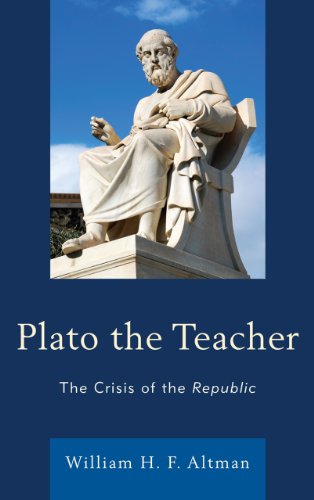
In this unique and important book, William Altman shines a light on the pedagogical technique of the playful Plato, especially his ability to create living discourses that directly address the student. Reviving an ancient concern with reconstructing the order in which Plato intended his dialogues to be taught as opposed to determining the order in which he wrote them, Altman breaks with traditional methods by reading Platos dialogues as a multiplex but coherent curriculum in which the Allegory of the Cave occupies the central place. His reading of Plato's Republic challenges the true philosopher to choose the life of justice exemplified by Socrates and Cicero by going back down into the Cave of political life for the sake of the greater Good.William H. F. Altman teaches Latin and World History at E. C. Glass, a public high school in Lynchburg, Virginia.
Plato the Teacher constitutes a major contribution to Plato studies and is striking in its profundity and originality. For Altman, Plato is first and foremost an educator, constructing his corpus as a whole and the Republic in particular so as to maximize their pedagogic punch. An educator can only be an altruist, and, for Altman, Platos altruism forms the very core of the Republic, whose essential ethical teaching for us all is found in Socrates directive to the philosopher-kings: 'You must go down.' Plato the Teacher abounds in startlingly fresh readings of passages that have grown stale, and is infused with clarity, erudition, and passion. Roslyn Weiss, Lehigh University
How Plato's dialogues ought to be arranged and, accordingly, how they are to be read, has provoked much debate. Some scholars believe that identifying their chronology of composition (the order in which they were written) is crucial to understanding Plato's philosophical development; others believe their dramatic order is of paramount importance. High school teacher Altman opts for a different yet altogether refreshing approach, ad