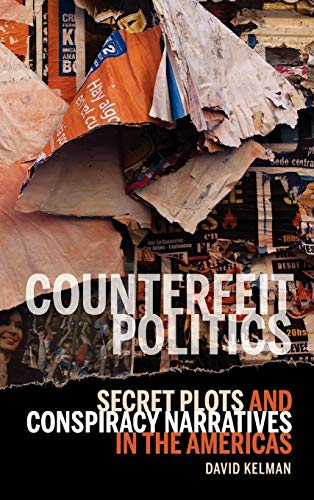
In Counterfeit Politics, David Kelman reassesses the political significance of conspiracy theory. Traditionally, political theory has sought to banish the paranoid style from the proper domain of politics. But if conspiracy theory lies outside the sphere of legitimate politics, why do these narratives continue to haunt political life? Counterfeit Politics accounts for the seemingly ineradicable nature of conspiracy theory by arguing that all political statements ultimately take the form of conspiracy theory.
Through careful readings of works by Ernest Hemingway, Ricardo Piglia, Thomas Pynchon, Don DeLillo, Jorge Luis Borges, Ishmael Reed, Jorge Volpi, Rigoberta Mench?, and ?ngel Rama, Kelman demonstrates that conspiracy narratives bear witness to an illegitimate or counterfeit secret that cannot be fully recognized, understood, and controlled. Even though the secret is not authorized to speak, this silence is nevertheless precisely what gives the secret its force. Kelmangoes on to suggest that all political statementseven those that do not seem paranoidare constitutively illegitimate or counterfeit, since they always narrate this unresolved play of legitimacy between an official or authorized plot and an unofficial or unauthorized plot (a complot). In short, Counterfeit Politics argues that politics only takes place as conspiracy theory.
David Kelman is assistant professor of English and Comparative Literature at California State University, Fullerton. He has published articles in New Vico Studies, CR: The New Centennial Review, ComparativeLiterature, Pynchon Notes, and Discourse: Journal for Theoretical Studies in Media and Culture.Owing equal parts to deconstruction and to political theory, and situated halfway between US Americanism and Latin Americanism, Counterfeit Politics is a rare book . . . Such a variety of registers will constitute an asset [to readers]. This review is of the opinion that the work is a valuable contribution t