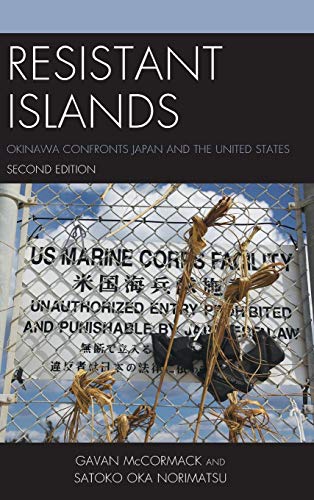
Now in a thoroughly updated edition, Resistant Islands offers the first comprehensive overview of Okinawan history from earliest times to the present, focusing especially on the recent period of colonization by Japan, its disastrous fate during World War II, and its current status as a glorified US military base. The base is a hot-button issue in Japan and has become more widely known in the wake of Japans 2011 natural disasters and the US military role in emergency relief. Okinawa rejects the base-dominated role allocated it by the US and Japanese governments under which priority attaches to its military functions, as a kind of stationary aircraft carrier. The result has been to throw US-Japan relations into crisis, bringing down one prime minister who tried to stop construction of yet another base on the island and threatening the incumbent if he is unable to deliver Okinawan approval of the new base. Okinawa thus has become a template for reassessing the troubled US-Japan relationshipindeed, the geopolitics of the US empire of bases in the Pacific.
Gavan McCormack is emeritus professor at the Australian National University.
Satoko Oka Norimatsu is an editor of the Asia-Pacific Journal: Japan Focus.
In recent years, the main source of friction in the USJapanese defense relationship has been local opposition to the basing of U.S. marines on the Japanese island of Okinawa. . . . McCormack and Norimatsu lay bare the resentments deeper historical roots. . . . The larger frame for McCormack and Norimatsus analysis is their sharply worded indictment of the USJapanese relationship, which they believe is constructed not so much to defend Japan as to serve a US forward deployment strategy aimed at Southeast Asia and China. Andrew J. Nathan, Columbia University,Foreign Affairs
The US bases in Okinawa continue to be an irritant in bilateral relations. This book shifts our focus from Tokyo and Washington to the perceptions and grievances