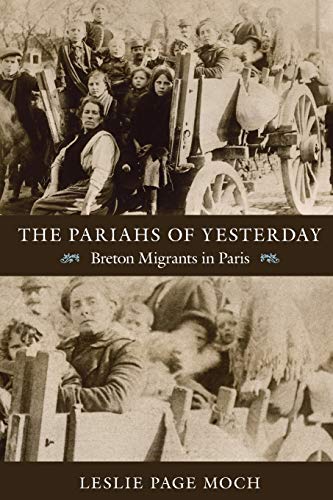
Beginning in the 1870s, a great many Bretons—men and women from Brittany, a region in western France—began arriving in Paris. Every age has its pariahs, and in 1900, the “pariahs of Paris” were the Bretons, the last distinct group of provincials to comeen masseto the capital city. The pariah designation took hold in Paris, in Brittany, and among historians. Yet the derision of recent migrants can be temporary. Tracing the changing status of Bretons in Paris since 1870, Leslie Page Moch demonstrates that state policy, economic trends, and the attitudes of established Parisians and Breton newcomers evolved as the fortunes of Bretons in the capital improved. The pariah stereotype became outdated. Drawing on demographic records and the writings of physicians, journalists, novelists, lawyers, and social scientists, Moch connects internal migration with national integration. She interprets marriage records, official reports on employment, legal and medical theses, memoirs, and writings from secular and religious organizations in the Breton community. As the pariahs of yesterday, Bretons are an example of successful integration into Parisian life. At the same time, their experiences show integration to be a complicated and lengthy process.
US
This work looks at the surge of Bretons who left their homes in Western France in the latter half of the 19th century to live and work in Paris. Portrayed as backward, ignorant peasants they found no welcome until after WWII. Moch positions her work within immigration theory, connecting migration studies to theories about state projects of assimilation and about cultures of inclusion and exclusion.
“The Pariahs of Yesterdaywill be the definitive work on Bretons in Paris. Leslie Page Moch is one of the foremost historians of European migration and here, through the eyes of contemporary observers and the microscope of marriage registries, Moch traces alongue dur&eacu