GEORGINA HICKEY is an associate professor of history at the University of Michigan, Dearborn.
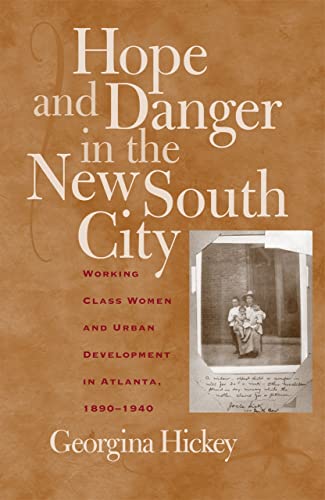
For Atlanta, the early decades of the twentieth century brought chaotic economic and demographic growth. Women—black and white—emerged as a visible new component of the city's population. As maids and cooks, secretaries and factory workers, these women served the "better classes" in their homes and businesses. They were enthusiastic patrons of the city's new commercial amusements and the mothers of Atlanta's burgeoning working classes. In response to women's growing public presence, as Georgina Hickey reveals, Atlanta's boosters, politicians, and reformers created a set of images that attempted to define the lives and contributions of working women. Through these images, city residents expressed ambivalence toward Atlanta's growth, which, although welcome, also threatened the established racial and gender hierarchies of the city.
Using period newspapers, municipal documents, government investigations, organizational records, oral histories, and photographic evidence, Hope and Danger in the New South City relates the experience of working-class women across lines of race—as sources of labor, community members, activists, pleasure seekers, and consumers of social services—to the process of urban development.
This book makes an original contribution to women's history, urban history, American studies, labor history, and southern history. The material is fresh and wonderfully developed; the writing elegant and vivid.
Tells a fascinating story about race, gender, and class.
A careful, well-researched and incisive study of the role of working-class women in the shaping of Atlanta . . . [This] is a fine study which brings the issue of gender fully into an understanding of Atlanta's development.