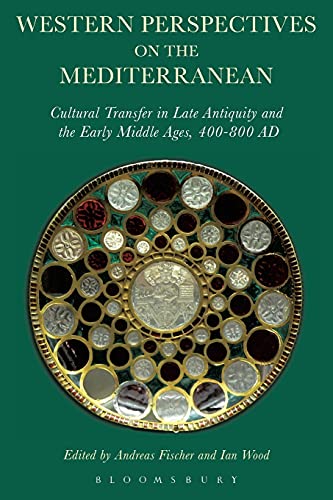
Based on close analyses of contemporary texts, and backed by an examination of the origins of the elements transferred and of the process of transmission, the contributors to this volume focus on the perception and adaptation of knowledge and cultural elements in the West. Taking a variety of approaches, they shed light on the changing lines of communication between the Byzantine empire and other parts of the Mediterranean, on the one hand, and the Burgundian, Frankish and Anglo-Saxon realms and the Papacy on the other.A high-level scholarly collection of articles on the transmission of knowledge and culture from a Mediterranean world politically fragmented by the fall of the western Roman empire and Islamic expansion into Latin Europe, 400-800 AD.
Andreas Fischeris Wissenschaftlicher Mitarbeiter at the Friedrich-Meinecke-Institut, Freie Universit?t Berlin, Germany.
Ian Woodis Professor of Early Medieval History at the University of Leeds, UK.
�Collectively, these six essays reveal vividly that the communication routes of the early medieval Mediterranean carried not only commodities, objects of devotion, and travelers themselves, but intangible cultural products as well.� �Gregory Halfond, Framingham State University, USA,Bryn Mawr Classical Review
�Readers who want to reconsider the Pirenne thesis will find much stimulating in ... the present volume. There are certainly many potentially interesting avenues for further investigation highlighted here.� �Early Medieval Europe
�It's hoped this carefully edited and stimulating volume will get international distribution. (Bloomsbury translation)� �Historische Zeitschrift
�The overall quality of the volume is high, it is thematically coherent and the papers make original contributions to their specific topics.� �JRS
�By shifting attention from the western post-Roman kingdoms to the broader regions of the Mediterranean, the six engaging papers