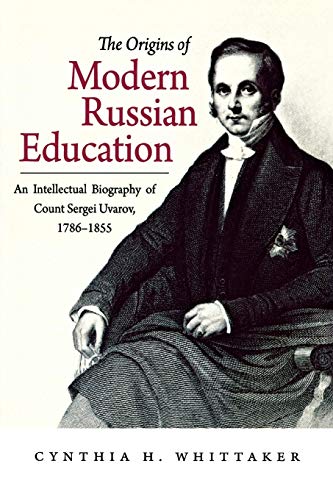
As minister of education and president of the Academy of Sciences, Count Sergei Uvarov was one of the most important statesmen in 19th-century Russia. But, because he has often been labeled as a reactionary and sycophant, his ideas and policies have tended to be dismissed as examples of the bankruptcy of the Russian “old regime.”
Whittaker’s intellectual biography, based on research in Russia and Finland, offers a striking reinterpretation of Uvarov’s career and of the quality of Russian intellectual life in his age and in assuring his country’s place in the mainstream of European educational development. With its wealth of new insights,The Origins of Modern Russian Educationwill be of interest to readers, specialists and nonspecialists alike, who are concerned with 19th-century Russian and with the history of education in general.
“This book is an important contribution to historical scholarship, rich both in pertinent details and insightful observations on the labyrinthine complexities of the poli