JAY WATSON is Distinguished Emeritus Professor of English and Howry Emeritus Professor of Faulkner Studies at the University of Mississippi. He is author or editor of twenty-one published or forthcoming books, including
Fossil Fuel Faulkner: Energy, Modernity, and the U.S. South, which won the 2023 C. Hugh Holman Award from the Society for the Study of Southern Literature;
William Faulkner and the Faces of Modernity, which won the 2020 Holman Award; and two University of Georgia Press publications,
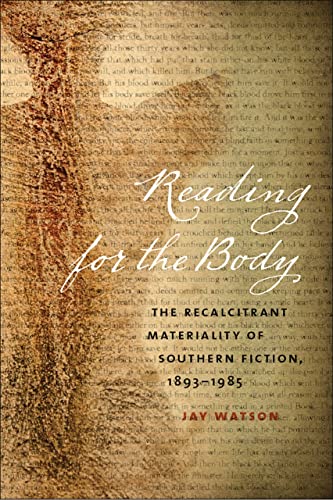
Reading for the Body: The Recalcitrant Materiality of Southern Fiction, 1893–1985, which received Honorable Mention for the 2013 Holman Award, and
Forensic Fictions: The Lawyer Figure in Faulkner. He
lives and writes in Mississippi and North Carolina.
Jay Watson argues that southern literary studies has been overidealized and dominated by intellectual history for too long. In Reading for the Body, he calls for the field to be rematerialized and grounded in an awareness of the human body as the site where ideas, including ideas about the U.S. South itself, ultimately happen.
Employing theoretical approaches to the body developed by thinkers such as Karl Marx, Colette Guillaumin, Elaine Scarry, and Friedrich Kittler, Watson also draws on histories of bodily representation to mine a century of southern fiction for its insights into problems that have preoccupied the region and nation alike: slavery, Jim Crow, and white supremacy; the marginalization of women; the impact of modernization; the issue of cultural authority and leadership; and the legacy of the Vietnam War. He focuses on the specific bodily attributes of hand, voice, and blood and the deeply embodied experiences of pain, illness, pregnancy, and war to offer new readings of a distinguished group of literary artists who turned their attention to the South: Mark Twain, Je