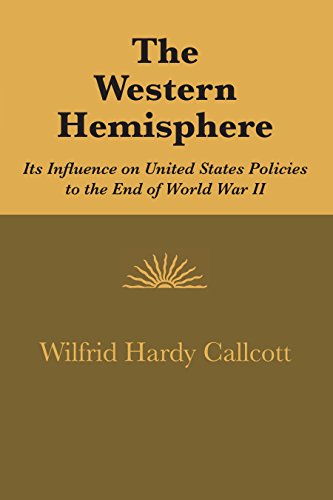
The Monroe Doctrine, "dollar diplomacy," the policy of the Good Neighbor—these well-known terms indicate the spectrum of the United States's relationships with its neighbors of the Western Hemisphere. Hemisphere thinking in the "Yankee" nation, founded on economic, political, and strategic needs, has come to encompass an appreciation of social and intellectual aspects as a vital part of a unified international unit.
InThe Western Hemisphere: Its Influence on United States Policies to the End of World War II, Wilfrid Hardy Callcott traces the rise of this awareness of the essential unity of the Western Hemisphere in international affairs. Although Callcott concentrates on the United States, he discusses all hemisphere countries, and his inclusion of Canada adds an additional dimension to previous studies on the subject.
From the early days of the Republic to the end of World War I, the relations of the United Stales with its neighbors gradually developed from mere curiosity and from on-the-spot decision-making into policy. During the eighteenth century the persons entrusted with United States foreign policy pressed forward with their own country's westward expansion, while they expressed only an academic interest in the affairs of other Western Hemisphere nations from Canada to Brazil.
By the end of the nineteenth century the United States had enthusiastically joined the imperialist nations. Although it soon replaced the use of force with economic controls, its military and economic manipulations naturally generated more fear and antagonism in the neighboring nations than cooperation and sympathy.
After World War I, attention to the hemisphere was fostered by the need for strategic raw materials that were to be found from Canada to South America, and by Old World rivalries and needs that endangered New World interests. Canadian and Latin American views of Europe and the League of Nations became much